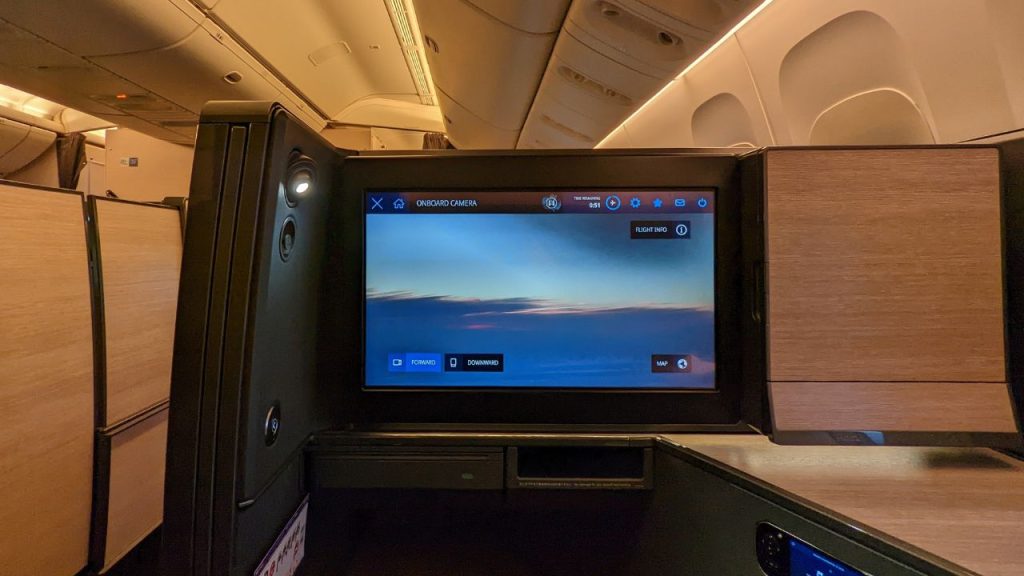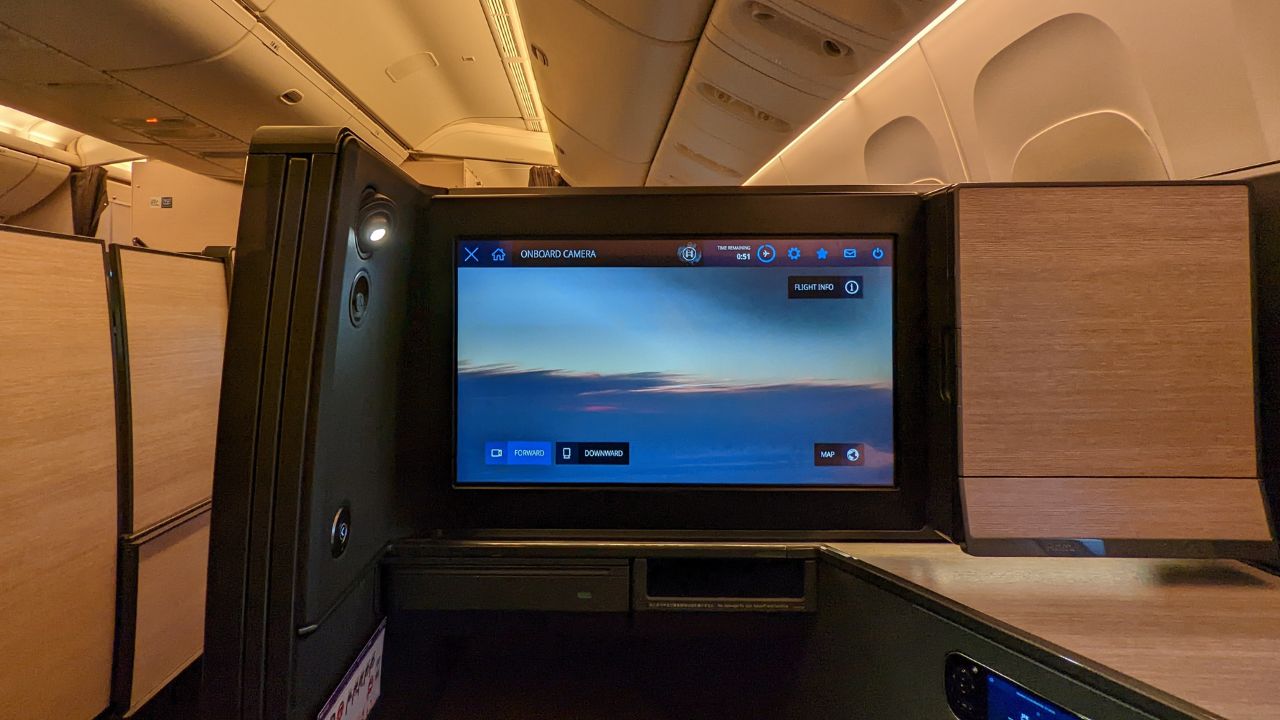
Imagine relaxing on an ultra-wide sofa in a 5-star hotel room in Japan — but above 30,000 feet. You can do exactly that on All Nippon Airways’s (ANA) new THE Room business class. As we fly from New York to Tokyo, let’s learn how ANA combines minimalist design with innovative industry firsts to create the ultimate Japanese experience in the sky.
“THE Room” is ANA’s first-ever business class with doors.
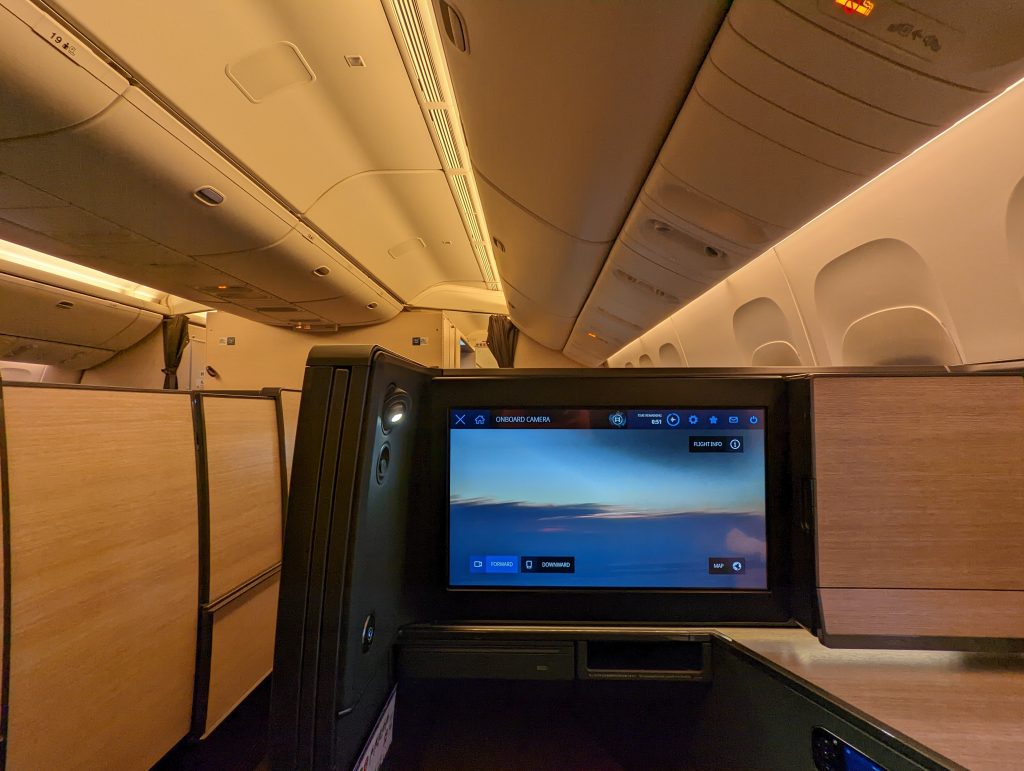
A typical Boeing 777-300ER has nearly 300 seats, but ANA chose a different strategy– they actually downsized in favor of customer comfort to a roomier 212 seats, 64 of which are the new private “THE Room” business class seats.
The entire cabin has been redesigned in collaboration between product design firm Acumen and Kengo Kuma, the Japanese architect behind the Tokyo Olympic Stadium. New galleys, new washrooms, new bulkheads, new first, business, premium economy, and even new economy cabins. (APEX, ANA)
Passengers are welcomed with soft ANA-blue lighting inspired by Japanese hotel lobbies.
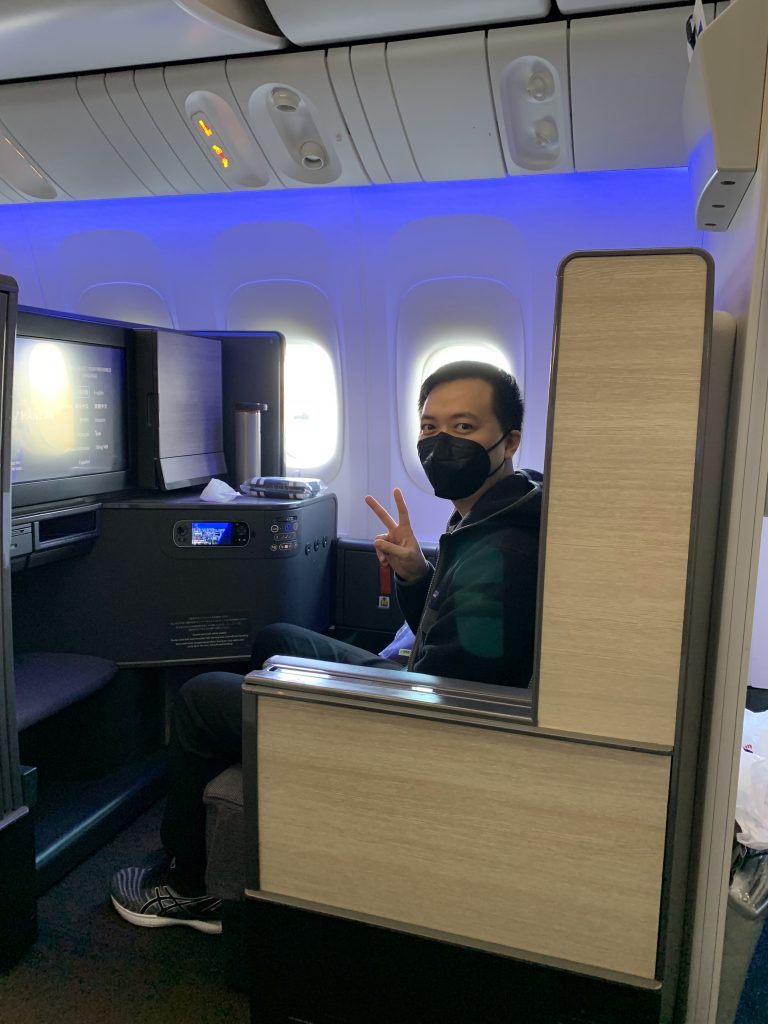
Thanks to new curtains and blinds in the kitchen galley, passengers no longer have to pass through a mini morgue with metal boxes and trays sliding bodies in and out during boarding. They’re even treated to soft blue ambient lighting and backlit decor panels that mimic traditional Japanese washi paper, creating a relaxing uncluttered boarding experience.
Natural wood finishes — common in traditional Japanese furniture — are everywhere.
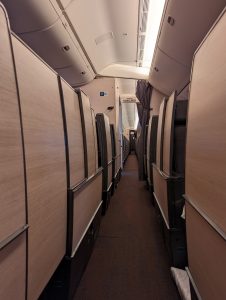
For centuries, wood is culturally symbolic in Japan and it’s no surprise to see it dominate the cabin decor. There are three wood finishes throughout — rosewood, light Japanese ash, and dark Japanese ash — each accented with a darker basalt slate stone that looks elegant, expensive, and low-key sophisticated. Even THE Room’s walls were architecturally designed so that the curves make the aisles feel less claustrophobic. It felt like being inside a 5-star hotel, rather than a phallic metal tube.
Before take-off, the crew offered welcome drinks served in plastic champagne cups.
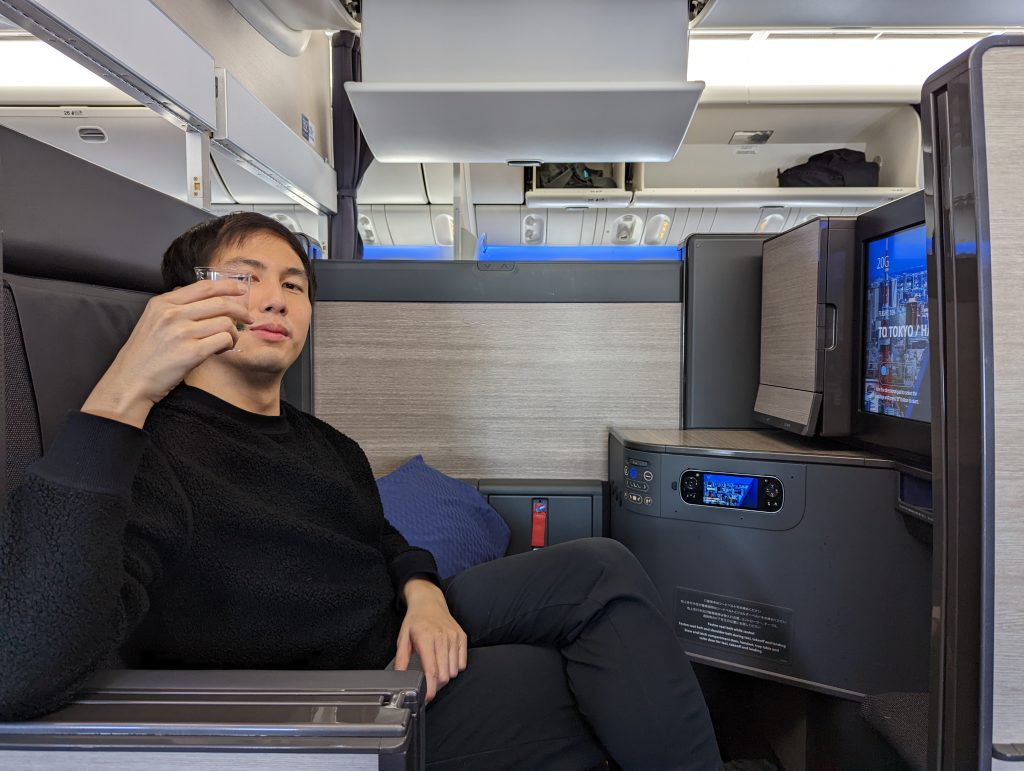
The seat is over 35 inches wide. Big enough to fit two.
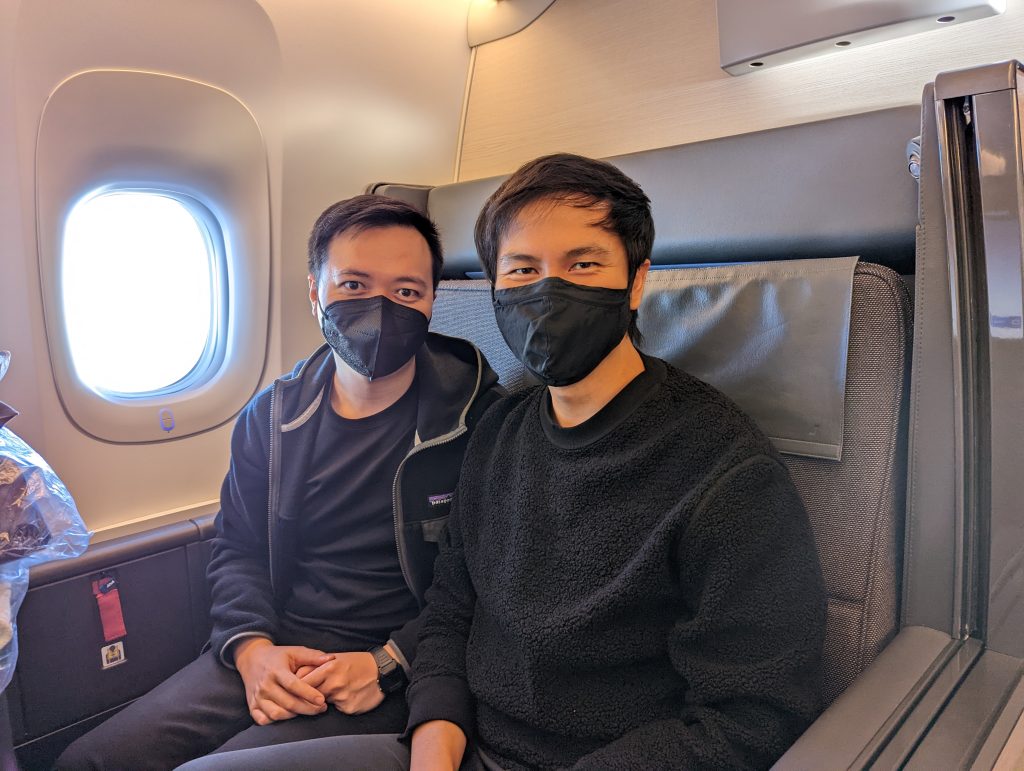
Impressively, the seat is a throne that’s nearly equivalent to two economy seats, which was wide enough to fit me and someone else — as long as I curb my weekly burger obsession.
Here’s what you’ll find at the seat…
- Soft blanket
- Two pillows
- Slippers
- Thin mattress pad
- Amenity kit, by British luggagemaker Globe-Trotter
The seats alternate between facing forward and facing backward.
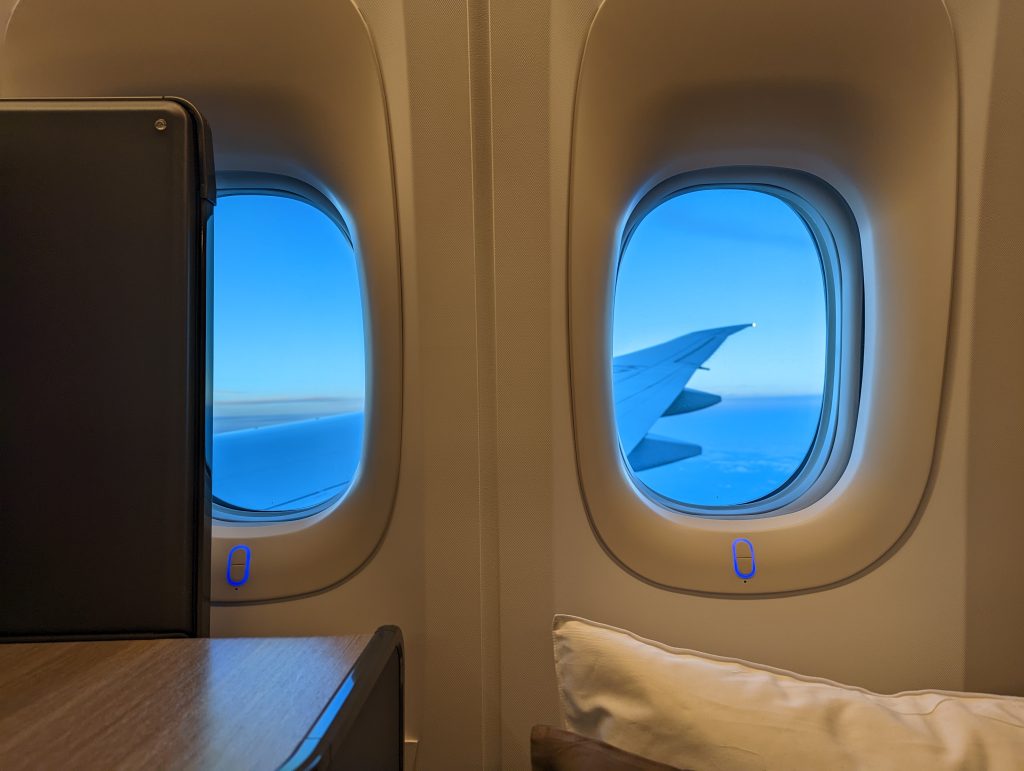
There’s no difference between a forward-facing and backward-facing seat, except passengers facing forwards won’t have to see the cruel sufferings of economy class.
If you’re traveling as a couple, I recommend seats 20G and 20H in the last business class row. There are fewer seats in this mini cabin, so it feels very private with the curtains closed mid-flight. You could do a TikTok dance and no one will notice. Although these seats are separated by an aisle, they’re still close enough to chit-chat, yet far enough to avoid mid-air couple disputes.
Storage spaces are hidden with clutter-free surfaces for maximum minimalism.
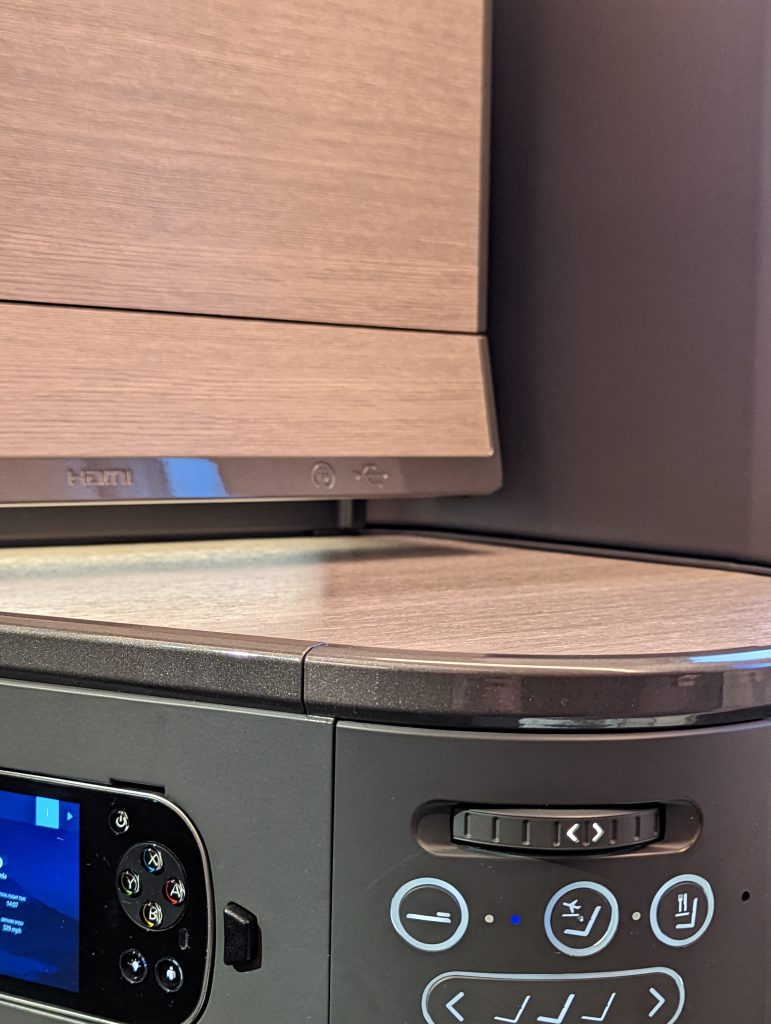
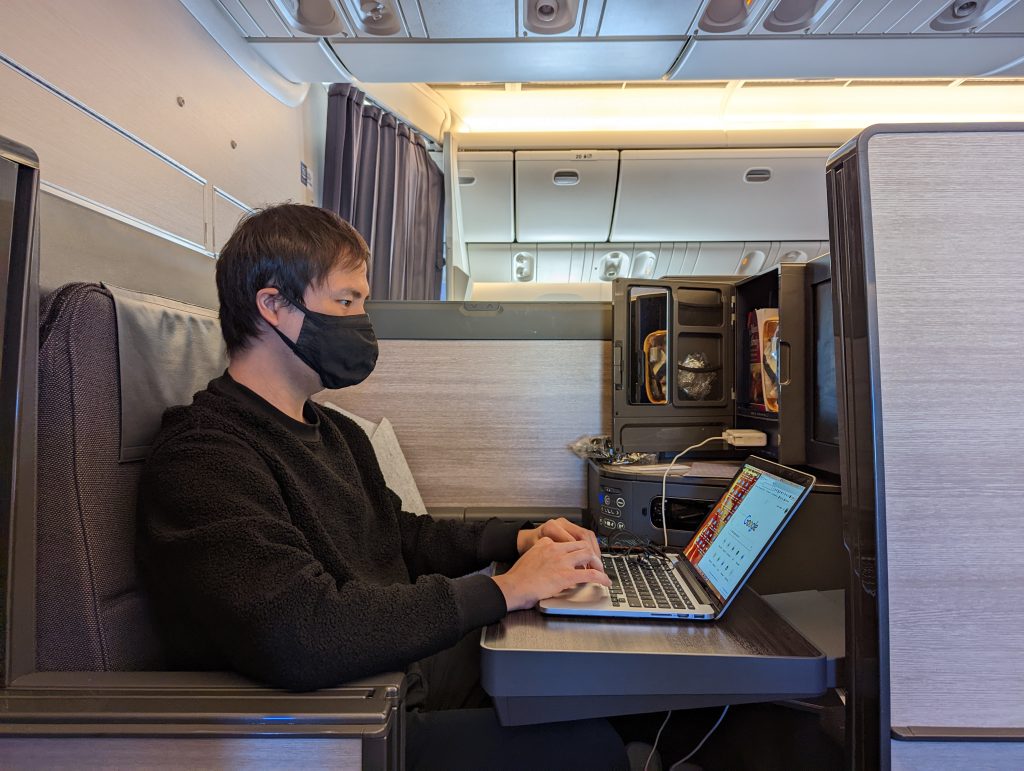
Next to the TV is a hidden cabinet for storage and enough connectivity ports to run a Crypto online business. It’s designed so that all the clutter disappears when the cabinet door closes, which is every minimalist’s wet dream.
Unfortunately, storage is tight and there’s not enough space to hold everything I carry as a peasant. I tried stuffing my noise-canceling headphones (Bose QC45) and toiletry kit into the cabinet, but the door wouldn’t stay shut. Eventually, I placed them out in the open, hoping no one would judge my messy non-Japanese methods.
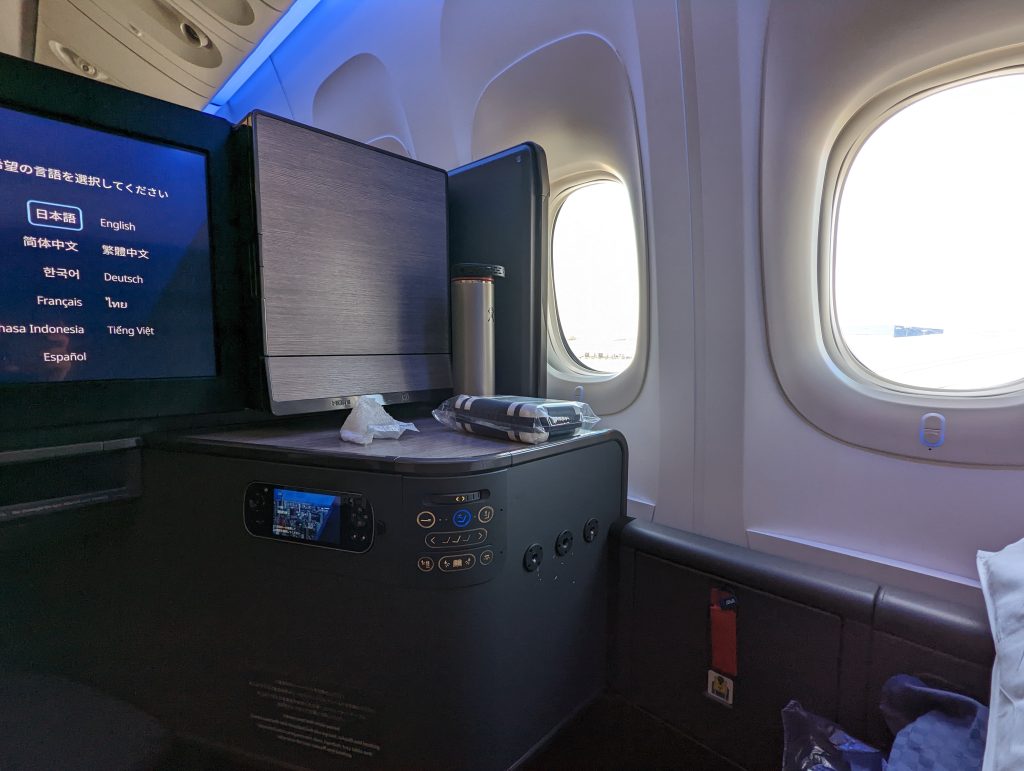
ANA is first in the world to introduce a 4K television at the seat, where we watched our escape from America in 24-inch high definition.
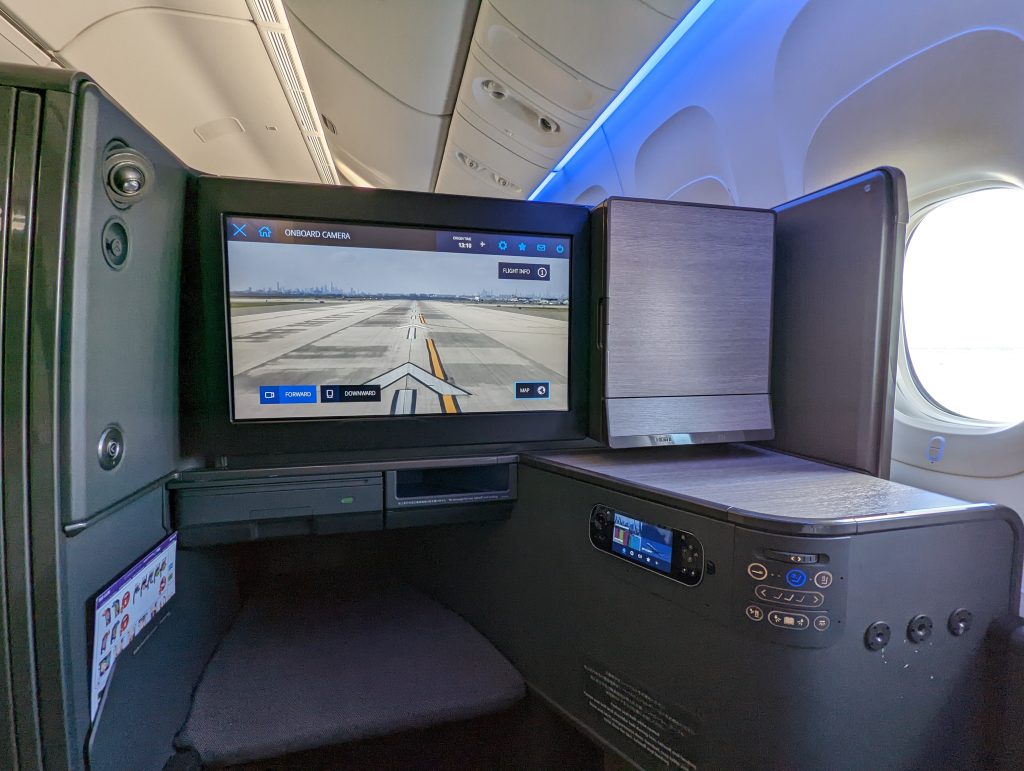
The work table slides completely forward, helpful for those emergency toilet runs.
ANA was the first airline to feature Japanese Kaiseki in-flight and the tradition continues.
From New York to Tokyo (NH109), two meals are served —
- A main multi-course meal after take-off.
- A lighter meal before landing.
There are two options for both meals —
- Japanese Washoku – Traditional Japanese cuisine, with fresh seasonal ingredients and rice on the side.
- International Cuisine – Western non-Japanese cuisine.
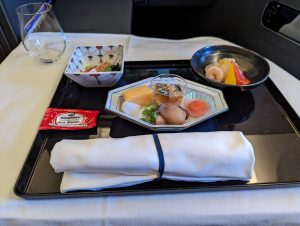
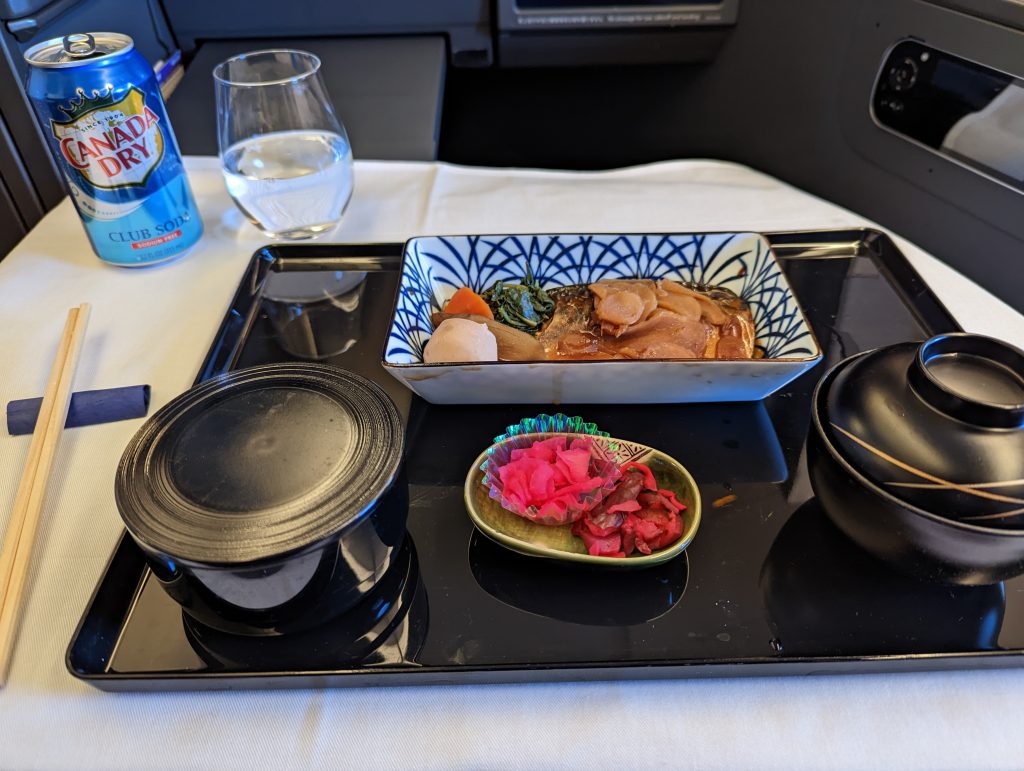
Food presentation is a critical aspect of Washoku. Since I didn’t pay thousands of dollars just to look at bread and steak tossed on a plate, I chose Washoku for both meals and it didn’t disappoint. Both meals were delicately plated and beautifully presented in Kaiseki style, a term used for elevated Washoku with multiple courses.
The main meal starts with amuse using familiar ingredients, such as edamame and mushrooms. This was followed by more sophisticated dishes, like grilled squid and simmered pumpkin.
Next up was sashimi. Yes, even on an airplane. Normally, I’d never advise anyone — not even my worst enemies — to consume raw fish on a long transpacific flight. However, I’d make an exception here. The fish was fresh and served cold to the bones.
Finally, the main course was a ginger mackerel dish complimented by pink Japanese pickles.
Here’s the full menu.
Indulge in three courses of flavors above 30,000 feet.
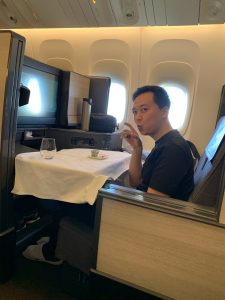
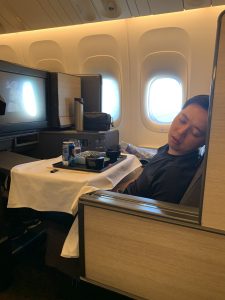
Pressing a button transitions the seat into a fully-flat bed.
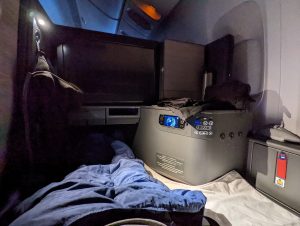
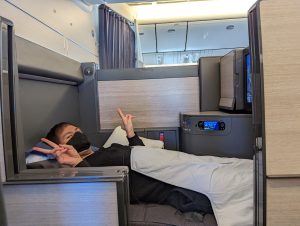
A scrolling knob moves the seat backwards, forwards, and also all the way into bed position. There’s no forced manual bed-making like a rebellious teenager. Although the bed is on the firmer side, there’s plenty of space to toss, turn, and man-spread in whatever position you desire.
A mattress pad is also provided, but it’s extremely thin. My theory is it’s not meant to be a mattress pad, but rather, it’s to create separation between you and the butt stains of countless travelers who have sat in the same seat before you.
Two door panels slide close to create a futon-like suite, inspiring the name “THE Room.”
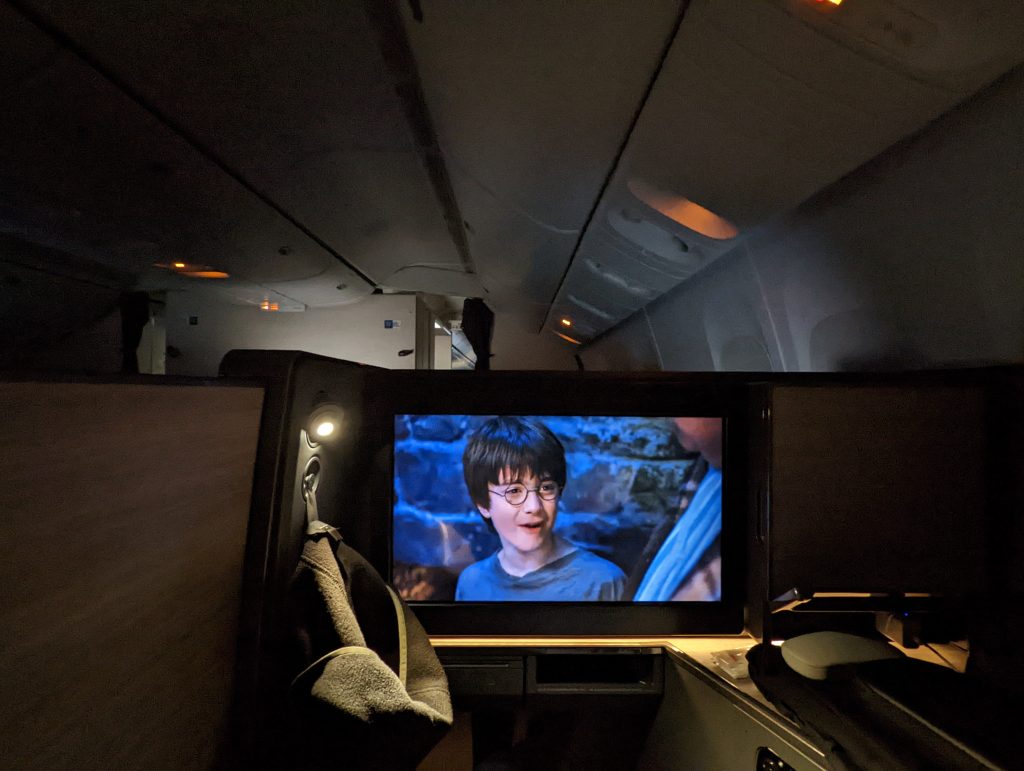
The doors sometimes required a long deep Herculean button press to close. But once closed with the seat fully flat, you’re inside a Japanese man-cave with a large futon. You can sit cross-legged or lounge around with Harry Potter playing on the massive TV screen.
THE Room is inspired by multifunctional Japanese living spaces and the designers intentionally removed anything unnecessary (Forbes). When the cabin lights are off, the suite glows like the soft-lit alleys of Kyoto. I appreciated that the suite felt simple and romantic, instead of giving the impression of a sleazy nightclub.
Some dishes can be ordered on-demand any time you want.
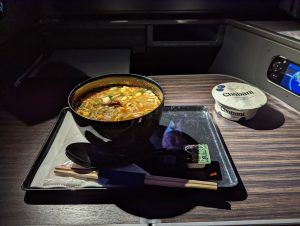
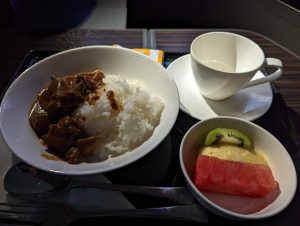
After the first meal, you can order anything you want if you’re still hungry. As much as you want, any time you want.
There are three light dishes to choose from, on top of the usual stomach-fillers like yogurt, fruits, and nuts. I recommend the corn soup or the Kayanoya vegetable soup. Kayanoya is well-known in Japan for its dashi stock, so this inclusion was a thoughtful way to introduce passengers to brands that locals enjoy.
I also liked the IPPUDO Miso Ramen. Again, IPPUDO is another well-known ramen shop in Japan. It’s vegan-friendly and tasted just as flavorful as some ramen I’ve had. Being able to enjoy ramen from an actual bowl in the sky is one of humanity’s greatest inventions.
THE Room offers a complete private dining experience when the doors are closed.
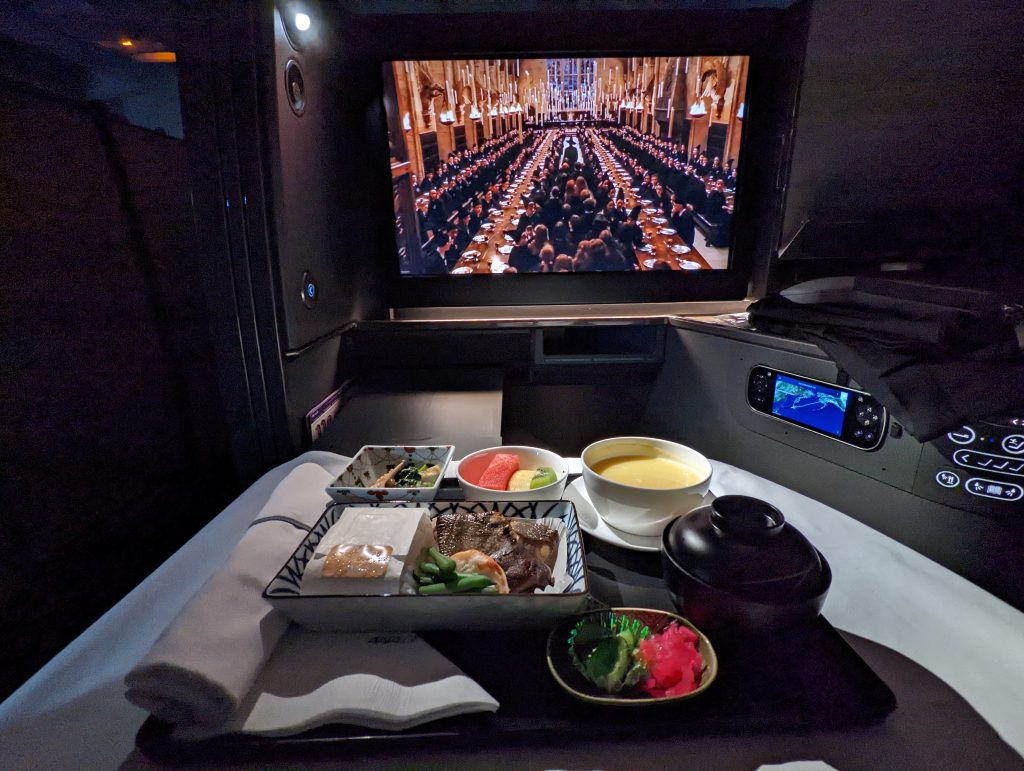
For the second meal, I ate it from the comfort of bed with the doors closed. Unlike the first meal, it’s served all on a single tray, so I pigged out in private like a wild animal and stuffed my face in one sitting. It consisted of a lightly-grilled amberjack and marinated vegetables on the side. Delicious. I later topped off the meal as all Asians do — with soup and fruit.
I paid $2,941.17 USD for 4 business class flights.
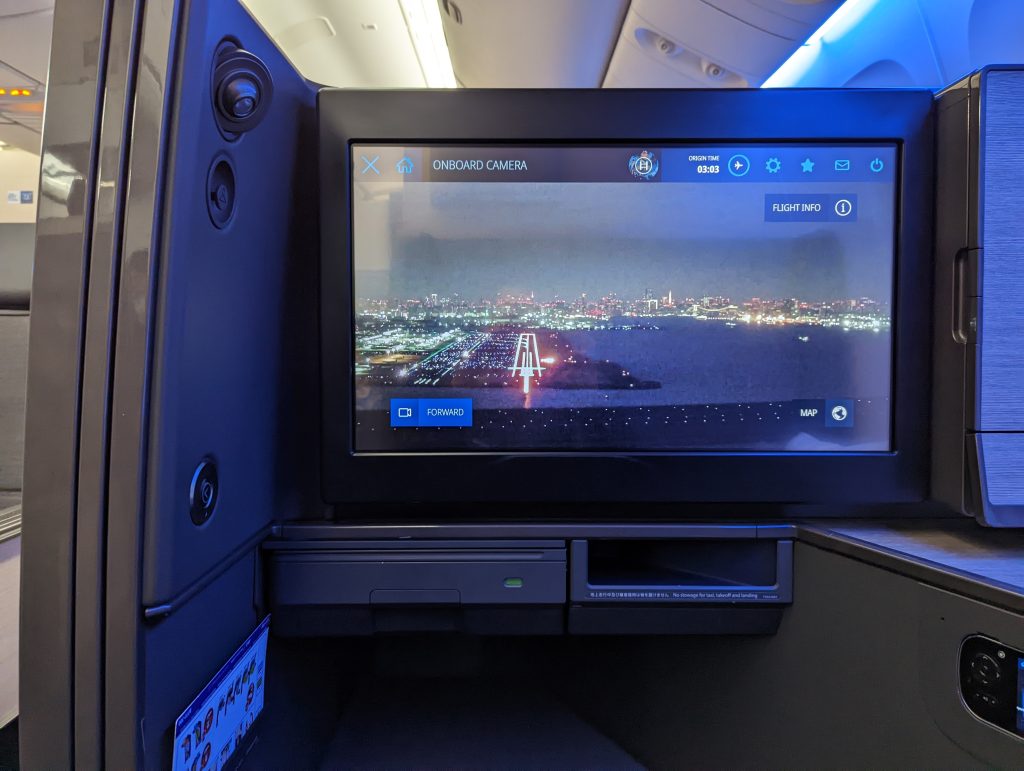
My itinerary was…
- NH109: New York JFK to Tokyo HND
- NH801: Tokyo NRT to Singapore SIN
- SQ960: Singapore SIN to Jakarta CGK
- NH856, NH110: Jakarta CGK to New York JFK, via Tokyo HND
I paid $2,941.17 USD after tax.
Note my tickets were cheap because I booked them just as Japan announced that borders were reopening after COVID. Today, expect to pay roughly $7,000 – $16,000 for the same itinerary.
Small details, like this farewell postcard, demonstrate why ANA deserves its 5-star ranking.
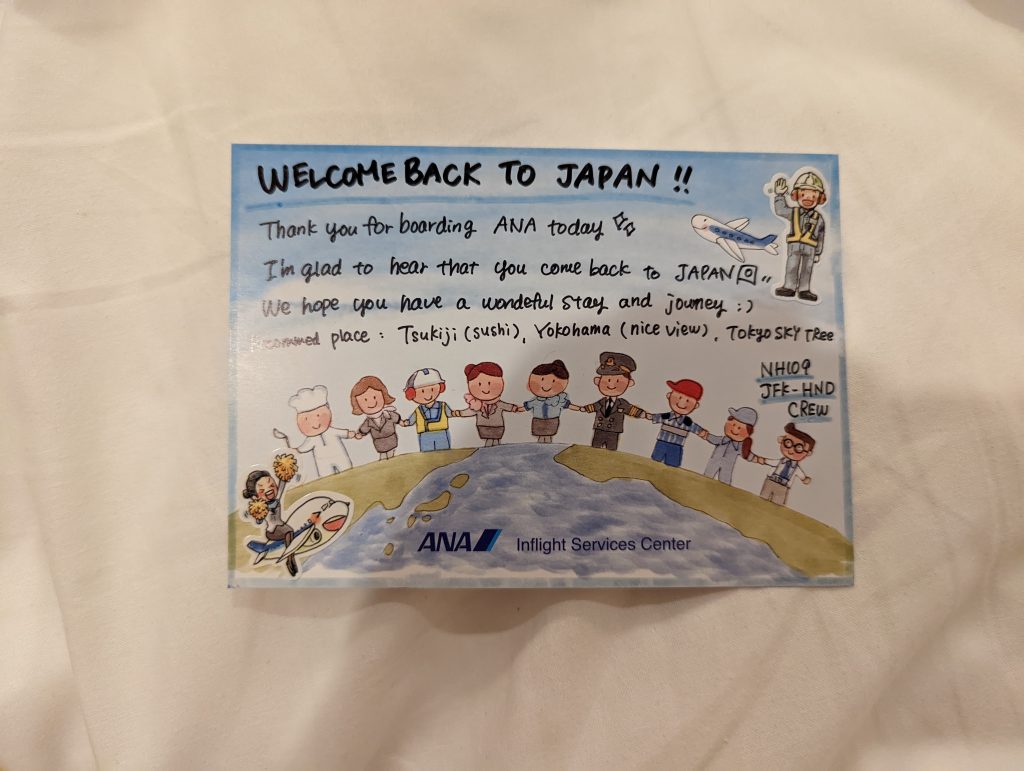
As we exited the plane, the crew surprised us with a handwritten postcard welcoming us back to Japan. Although it’s just a piece of paper, it was a nice surprise and I’ll never forget that moment.
From the thoughtful seat design, to the exquisitely-prepared meals, to the friendly crew willing to help with any request, my flight experience mirrors the same Japanese hospitality you’d find in a typical Japanese ryokan. If I win the lottery, you can bet the first thing I’ll do is book another ticket to Japan in THE Room.